|
|
 |
| |
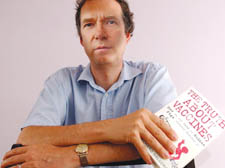
Dr Richard Halvorsen is calling for more research into children’s vaccines |
MMR: the trials of finding the truth
Family doctor says onus should be on advocates of the controversial jab to prove it is safe
FIVE years ago, at the height of the controversy surrounding the MMR jab, GP Dr Richard Halvorsen was asked to write an article on the subject for a Sunday newspaper. What he uncovered disturbed him.
“I started talking to people. I thought, well, there’s this story about autism and bowel disease and MMR – I wasn’t totally convinced but I thought the question warranted being answered,” said the doctor, who has a practice in Lamb’s Conduit Street.
“So I turned to the government’s studies, expecting to be reassured, and that’s when I became concerned. There was a total lack of evidence that it didn’t do these things and that it was safe.
“So I wasn’t convinced by the evidence that it was dangerous, but I was even less convinced that it was safe – and we were talking about a vaccine that affected every child in the country.”
His curiosity sparked, Dr Halvorsen spent the next five years researching all the vaccines commonly offered in the UK, including the MMR (a triple measles, mumps and rubella vaccine). The result is a controversial new book aimed very much at parents: The Truth About Vaccines: How We Are Used As Guinea Pigs Without Knowing It.
Dr Halvorsen’s central argument, based on interviews with experts from both sides of the fence, is that too many vaccines are given to children with too little research into their potential side-effects. There are a staggering 27 vaccines on offer to children in the UK within the first 15 months of their lives.
“Fifty years ago, when vaccines were introduced for illnesses that were both serious and common at that time – like diphtheria and whooping cough – the vaccines would go through many years of trials before they were introduced,” he says.
“What’s happening to children now is very different. The number of vaccines has increased dramatically and we’re not having the debate. Could there be a maximum number at which we should stop – perhaps at 50, or 100?”
Citing an alarming rise in autism and childhood diabetes – “diabetes in children under five was virtually unheard of 20 years ago” – he adds: “I’m not saying that vaccines are the main cause of it, but we are vaccinating an awful lot of children under five.
“Because we don’t do the long-term trials to test whether they could be a factor, we’ll probably never know.
“The scary thing is the vaccine expert who said we’ve now got past the point of finding out what the side-effects are – because we are putting so many together that you’ll never know which one causes the problem.”
While Dr Halvorsen supports some vaccines whole-heartedly – diphtheria, polio, tetanus and a single measles vaccine – he is also against mass immunisation.
“What I’m against is this indiscriminate mass vaccination without adequate testing for safety and effectiveness,” he said.
And what of the MMR scare that sparked the current debate? Unsurprisingly, Dr Halvorsen has considerable sympathy for the former Royal Free gut specialist Andrew Wakefield, who first raised concerns about its safety. Mr Wakefield is currently up before the General Medical Council on charges of serious professional misconduct.
Dr Halvorsen said: “One of the problems at the moment is that we’re able to have a debate that doesn’t involve personal attacks and unbridled passion. If you stand up and challenge the policies of vaccination – and I use Andy Wakefield as an example – you risk being accused of putting children’s lives at risk.
“There is no conclusive proof that MMR causes autism but there is evidence that it does – it’s just how strong you think that evidence is. Several thousand parents think their child has autism caused by the vaccine – that may be totally unscientific but it doesn’t ring true to me, as a clinician working with parents on a daily basis, that they would all be wrong.
“There is such an assumption that vaccines are good and safe,” he added.
“So the onus is on those who think there is a problem to prove beyond doubt that there is a problem – rather than those who are putting out the vaccines to prove beyond doubt they are safe. That should be the case when you are providing a substance to every healthy child in the country.”
|
 |
|
| |
| Your comments: |
| |
| |
| |
|
|
|


