|
|
 |
| |
Sickert: A good murder suspect
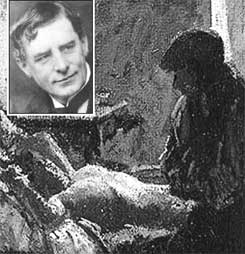
A detailed study uncovers the mundane and magical aspects of the life of Camden Town artist Walter Sickert, writes Gerald Isaaman
Walter Sickert: A Life
by Matthew Sturgis. Harper Collins, £30 Order this book
MATTHEW Sturgis was born in Gloucester Crescent, Camden Town, just a few doors from the house where Walter Sickert once lived. “So he was a neighbour and I suppose I must have kicked my football into his garden at some time,” he says with a smile.
He lives now a little further south in Warren Street, where the peripatetic painter once had one of his many backroom studios in odd lodging houses around Camden, taking this one after telling bemused landladies that he was searching for “paradise”.
Perhaps the fact that Sickert and Sturgis were born exactly 100 years apart, give a few days, Sickert in 1860, has put them on a parallel path.
Undoubtedly it helped Sturgis with his research over the six years he has been working on Sickert’s biography.
Certainly Sturgis has been strangely haunted by Sickert in other ways too, aware of his presence walking the streets of Camden, and seeing that blue plaque to him in Mornington Crescent.
On the wall of the family home hangs a Sickert, a painting originally given to Sturgis’ maternal grandfather, himself an amateur artist, to mark his retirement from his role as boss of the firm K shoes.
role as boss of the firm K shoes. Yet it wasn’t until after he wrote a biography of Aubrey Beardsley, to whom Sickert was a generous friend, and saw the major 1980s’ exhibition of late Sickert works at the Hayward Gallery that he realised that no significant biography existed.
“Sickert was such a huge person in the artistic life of the nation,” he points out.
“He is unknown and unloved by the general populace but in the artistic world there was a feeling that here was someone important about whom people want to know more. And he was such a tremendous maverick too.What is extraordinary about Sickert is that, though he was a painter who poured his energy into the passion of his life over 60 years, there was so much else happening because of his great generosity of spirit.”
Sturgis has not counted the words that fill the 768 pages of his biography, already much applauded by the critics, but he has painted in with devotion and delight all the secret and subtle colour in the shadows of truth that Sickert sought himself.
He has been to the USA to search out new, un-edited and hard to read letters that Sickert, the prolific journalist, wrote in abundance.
He visited Paris too on the same mission, visited all the places Sickert knew intimately, from Dieppe to Sutherland to Venice, and discovered that he had an illegitimate daughter who died as a child before knowing her father.
The result is that he sees Sickert in all his elements, living on the edge as well as in the clasp of high society, and provides us with virtually daily detail of the daft and the trivial, the great and defining moments in an extraordinarily lived in life.
Here is Sickert in all his strengths and contradiction. The Munich-born son of a Danish artist and his English wife, a dashing, handsome, charming man full of ideas, equally difficult, daunting and dominating who lived in a world of disorder, yet allowing nothing to sway his confidence in his talents. “All you need to know is which end of the brush to put in our mouth,” Whistler, an inspiration along with Degas, told him.
And so he became his acolyte and even wrote speeches for the ‘Master’. Later, Sickert taught Winston Churchill to paint. Yet Sickert, an equally radical impressionist, went off abroad to chase his star – and discovered Camden Town and the wonders of the Old Bedford Music Hall now missing from the High Street. More importantly, he became the father and inspiration of the Camden Town Group with Gilman, Gore and Bevan.
“He wanted to strike out in a new direction,” explains Sturgis. “His first studio was at 13 Robert Street, now taken over by council flats, where he began painting images of the area in the late 1890s.
“Then, when he returned from his exile abroad in about 1895, he came back and took rooms in Mornington Crescent.
“He had this belief that places had a particular character and stimulus which was real but would last only for so long. He would take a studio and get lit up by its sense of place and the quality of sunlight bursting through a grimed window pane in some third floor back bedroom. That was absolute magic for him.”
So it was that Sickert can be found at various times in Albany Street, Augustus Street, Charlotte Street, Warren Street, in Tufnell Park and in Broadhurst Gardens, West Hampstead, his home with his first bride
There is so much else, and it has to be thanks to this compelling biography that Sickert’s lost, later days when he scrambled for a living can be resurrected, and the painter too often ignored as unfashionable given his proper place and the tribute he deserves, not least as the teacher of today’s avant garde.
Finally, Sturgis provides a postscript that devastates the crazy allegations of the American thriller writer Patricia Cornwell that Sickert was really Jack the Ripper, his gruesome Camden Town Murder paintings having set so many silly tongues wagging over the years.
Sickert simply was in Dieppe when some of the deaths took place and the Ripper claims are proved to be made of sand.
Sturgis concludes: “As Sickert himself remarked, ‘It is said that we are a great literary nation but we don’t really care about literature…we like a good murder.’ And we like a good murder suspect.”
 |
|
|
|