|
|
 |
| |
Veg is the spice of life on Mick’s allotment
A witty guide to growing vegetables has the perfect balance between information and humour, writes Dan Carrier
Close to the Veg: A book of Allotment Tales by Michael Rand. Marlin Press, £10.99 order this book
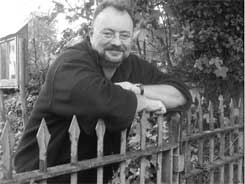
MICK Rand likes to eat dead Victorians – and has even rustled up a mushroom stew that has traces of Karl Marx in it.
The author of The Communist Manifesto inadvertently helped Mick grow a bed of oyster mushrooms. Such a tale is one of the many amusing stories Mick has chronicled in an autobiographical gardening book that reveals how a man who couldn’t tell his cabbage from his kale has turned green fingered.
I volunteered to help clear some of the vegetation in Highgate Cemetery,” he recalls.
This involved taking down a number of hazel trees growing around Marx’s tomb. Mick could not resist recycling the wood on his allotment – and stacking up some of the coppiced hazel branches to make a bed on which to grow oyster mushrooms.
“I got a great crop,” he said. “Inadvertently it means I have eaten mushrooms that have been grown off the nutrients provided by dead people.”
But Close To The Veg is more than a light-hearted, gentle tale of creating a rural paradise in our urban sprawl.Through his allotment, Mick has not only nurtured vegetables, he has grown a philosophical approach to life.
Mick’s main concern is how to improve the soil to yield better crops. So he became fascinated in what to do with the soil. He becomes a player in the composting league: what will decompose nicely into the Fitzroy Park soil? And it has given him a grander vision of his placewas inspired by his time on the plot to do a environmental science degree at the Met University on the Holloway Road, and through the knowledge gleaned, improve his crops. He sums it up by telling the reader how all the bits and bobs that make up our bodies – the nutrients, the matter etc – have come from somewhere. “Our bones are made up of calcium that once formed the bones of dinosaurs,” he states. It is a Jurassic fact that can explain the creaks in my knees.
His story starts when a letter from Camden Council telling him he was near the top of the waiting list for an allotment at Fitzroy Park, Highgate.
“I read it with bewilderment,” he recalls.
“My mind jumped back to a small bar off Oxford Street where an evening of hilarity had ended with the disappearance of my bag.
“This contained my passport. My first thought was that this surely must be one of those cases of ‘identity theft’. Some desperado was pretending to be me in order to swindle the council out of one of its allotments.”
However, he remembered he had put his name on a waiting list around five years ago.
From this starting point, Mick’s book becomes a curious hybrid: it tells the story of how one novice has turned into an expert through trial and error.
But it also reads like a gardening fact book. You could follow his instructions to create a vegetable patch.
“I wanted to show the reader how straight forward growing your food can be,” he says. “There are no secrets, just using science in a way that makes it work for you.”
And a brief tour of the plot show how successful he has been.
It is neatly laid out, with brick paths snaking through terraced beds, and a shed built out of scraps of wood Mick has taken off skips. This is a recurrent theme of Mick’s book: he loves to find something others have thrown out and turn it to good use.
He has turned old windows into cold frames, estate agents’ hoarding poles into fruit frames and the hazel sapling mushroom beds from Karl Marx’s tomb.
“We live in a wasteful society,” he says.
“This is a new phenomenon, something that would have been impossible in our past. Our ancestors could have lived as wealthily as their kings on the contents of our modern dustbins.”
He suggests pillaging skips, because “it is not only saving the Earth, even better, it is saving yourself the Earth.”
This makes his allotment unique – there have been no trips to garden centres for Brookside Close-style sheds.
His shed is made up of a number of odd off cuts: it’s the type of work space W Heath Robinson would be proud of. Other contraptions include homebuilt chairs – a bench at the north end of the plot includes two carved bottom imprints for added comfort – and a no sweat soil granulator. This contraption consists of two Aframes with a sieve hung by rope in the middle.
His shed is made up of a number of odd off cuts: it’s the type of work space W Heath Robinson would be proud of. Other contraptions include homebuilt chairs – a bench at the north end of the plot includes two carved bottom imprints for added comfort – and a no sweat soil granulator. This contraption consists of two Aframes with a sieve hung by rope in the middle.
“I am interested in what food I eat now, whereas I wasn’t before,” he says.
The final chapter underlines the joy of growing food. Mick’s Six of the Best looks at the vegetables that have been the most successful on his plot; sweetcorn, asparagus, broad beans, tomatoes, wheat – which he uses to bake his own bread – and finally the necrophiliac mushrooms.
up some coals on a barbecue ready to receive a freshly-picked corn is mouth-watering and sums up the book’s philosophy.
“In terms of getting the sweetest sweetcorn, timing is the key,” explains Mick. “Our record, with a chucker at the corn patch, a catcher over at the coals and a time keeper standing by, is two and half seconds from off the plant to on the barbecue. A speed and economy of moment beyond the maddest dreams of the most efficient commercial distributor.”
|
| |
|
|
|
|