|
|
 |
| |
Jazzy George shows no sign of slowing down
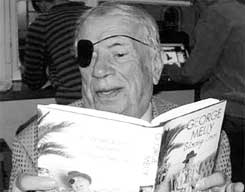
George Melly is one of our more colourful cultural pundits – and he is helping to keep the jazz and blues flag flying, writes Graham Tayar
Slowing Down by George Melly
Viking, £17.99 order this book
JAZZ is a minor but important (to many of us) art form, covering approximately the 20th century and onwards, though its roots go much further back into American history, black and white. And although Britain is a marginal part of the jazz world, it has produced many fine jazz musicians, particularly since World War II.
Among them, perhaps the most colourful, eccentric, polymathic, and popular is bluessinger George Melly, still belting out the music after more than 50 years in the business.
After public-school (Stowe, where it’s been claimed something interesting happened with Peregrine Worsthorne), the Royal Navy, which he describes in an earlier biography ‘Rum, Bum and Concertina’ (it was still his gay period), assistant in an art gallery specialising in Surrealism – George once wrote surrealist poetry himself – he went on the road for ten years with Mick Mulligan’s band.
There was a long gap in the 1960s, when he became television and film critic for The Observer. As Critic of the Year in 1970, strip-cartoon wordster for Wally Fawkes’ Flook, arts commentator on TV, radio and in his own seminal book, ‘Revolt into Style’ and most of all as the witty frank chronicler of his many lives, George was a major cultural pundit.
But at heart, he was still a performer. Singing – occasionally – still in the style of Bessie Smith and visibly always delighted by the applause that for 30 years and more has sustained the longest stage come-back in show-business history. At the time, I thought the Melly revival would last three or four years until he got bored with it. I couldn’t have been more wrong. He’s continued to live all his lives simultaneously.
Now at nearly 80, George is very deaf, suffering from “incipient emphysema”, (he is still a smoker) and an occasional “unexpected attack of violent diarrhoea”, often in such inappropriate places as the Victoria and Albert Museum.
His active sex-life is over. “If we retain any sense, we will avoid flirting, remembering that the very idea of randy old tortoises is repulsive to anyone we might fancy, and besides I’m completely impotent and, even if I weren’t, I am sexually indifferent to those of my age group,” he writes.
George nevertheless copes quite well, with his anecdotal skills unimpaired, and his reminiscences as sharp and funny as ever. And he can and does continue to perform.
“In my late 70s, I am still able to play at senility, enjoying supportive friends, singing, albeit seated and wearing an eye patch, drinking Irish whiskey, fly-fishing for trout, looking at works of art and listening to Bessie Smith, the Empress of the Blues. I imagine this last will be the last to go.”
And later he adds: “I’m not, they tell me with some surprise, in bad nick.” All things considered, he is a survivor, though the early chapters of this book, largely on his symptoms, doctors and treatments, provide good reasons for entitling it ‘Slowing Down’.
Then he moves on to his return to full-time singing, 30 years ago, via Sunday lunch-times at the Clerkenwell pub ‘New Merlin’s Cave’, where Duncan Hamilton and I had managed to persuade the King’s Cross police station Chief Superintendent to legalise (or at least allow) jazz-loving parents to bring their small children with them for a civilised family drink.
But for George, with the John Chilton’s Feetwarmers, it provided a jump-off point for an amazing and lasting breakthrough as he became – and has remained – a national popular hero.
Part of his support has come from middle-aged and elderly jazz fans who saw him recreating their own long-lost youth. But the genuinely young, students and the like, also find George’s style, warmth, and charisma irresistible. Among other virtues, he and his bands have exposed jazz to those who otherwise would never have heard of it, or listened to it.
Rock ’n Roll may rule – but he has helped keep the jazz and blues flag flying.
In his account of the last three decades, George underlines the parts played by others in his revival, trumpeter, band leader and writer John Chilton, modern jazz stalwart Ronnie Scott, at whose club, the Melly show has played over 30 Christmas seasons, promoter and publicist Derek Taylor, the formidable agent Jack Higgins, they are all precisely and wittily put into context as George digs up his past.
It’s all good not-soclean fun, stuffed with Melly stories and asides – on Joan Bakewell, “Good Old Joan.You are still this ageing impotent man’s crumpet,” on Liza Minnelli, Judy Garland’s daughter, and a star guest at Scott’s, “she batted her long eyelashes at me and said, Momma would have loved your numbers.
“Could she have told me anything more calculated to please?”
They are all there, family and friends, scattered through these pages, his mother Maud, my distant cousin, who tried to join the RAF when well over eighty, his wife Diana, the wing commander who has steered him and supported him over the years.
A delicious and entrancing read, ending with his own parody of Betjeman, ‘Melly’s Churchyard.’ But why did he prematurely consign poor Diana to this graveyard list? And Maggie Hambling, whose line drawings enrich the text? A slight attack of Surrealism perhaps? Never mind, it’s a smashing book.
|
| |
|
|
|
|