|
|
 |
| |
Learn from Victorians
to break Islamist terror
A crime expert tells Peter Gruner that we must have more women police and historic knowledge
Dead Loss by Joan Lock
Severn House -Sutton, £18.99 order this book
TWELVE people died and 120 were injured when Irish Fenian terrorists – forerunners of the IRA – blew a hole in Clerkenwell Prison in 1867 in an attempt to free two comrades.
Londoners lived in a state of fear with bombs going off at railway and underground stations, the House of Commons and Scotland Yard, between 1860 and 1886.
Islington crime writer Joan Lock – chairwoman of the influential Crime Writers Association (CWA) Gold Dagger for Non-Fiction award – sees similarities between 19th-century Irish terrorism and the July attacks.
The ex-police officer started writing her latest novel, Dead Loss, based on the Fenian outrages, just a few months before July 7.
“The Fenians set dynamite bombs off all around London,” she said. “They blew them up in luggage lockers at Victoria station and under London Bridge. They threatened Queen Victoria and the Prince of Wales.
“The authorities were so scared the Queen’s train would be bombed that they ran a ‘pilot’ train on ahead in case explosives were planted.”
Like today, police tried to outwit the terrorists – often at the expense of tackling other crimes.
Mrs Lock believes there may be lessons from the way that Fenian terrorism eventually fizzled out in 1886, albeit to return later.
“First, there was a political will to understand the Fenian cause and talks began about Home Rule for Ireland. Second, the Fenian terrorists themselves were out of favour with the Irish community in London, who were being made scapegoats and victimised by the English.
“Third, the police, originally caught off guard, began successfully apprehending the terrorists by sheer dogged detective work.”
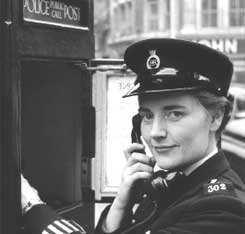
And that’s where Mrs Lock, who lives off Liverpool Road, really comes into her own. With six years under her belt as a Woman Police Officer, or WPC, in the West End, she is able to add authenticity to her writing.
Married to a policeman – Bob who was based in Marylebone but sadly died two years ago – Mrs Lock joined the service in 1954, often dealing with vice and prostitution around Soho pubs.
The first WPCs were introduced during World War I but even in the 1950s women police were still something of a rarity. She left the force at 27 in disappointment, realising she would never be promoted.
She took up writing while working part-time as an in-house trade journalist and turned professional at 50 and hasn’t looked back. Her first book, about her experiences as a WPC, was published in 1968. Mrs Lock has lectured and campaigned for better rights and conditions for women in the police
Dead Fall, due for release at Christmas, is a meticulously researched and readable account of a murder at a theatre in Oxford Street.
It includes atmospheric scenes from around Islington in the mid-19th century.
Barnsbury’s Lonsdale Square is included, built in 1842 when ‘London’s Dairy’, as Islington was called, “began its rapid metamorphosis from a place of cattle lair, pasture land, pleasure grounds and market gardens into a desirable suburb for the Victorian middle classes”.
Dead Loss, she said, was inspired by a book costing 40p from a library.
“It was called Victorian Theatre and was full of articles culled from Victorian stage papers and newspapers,” she says. “It dealt with the managers, the life of the actors, and gave me a good insight into those times.”
Part of a historical crime series, Joan’s novel features her sleuth, Detective Inspector Ernest Best.
She is author of eight non-fiction crime books, including two on Scotland Yard’s first detectives and the history of the British women police.
At 71 she is worried our society has become a lot more violent.
“We’ve gone from being perhaps too authoritarian in the 1950s to today’s climate in which people are free but fearful at night. We definitely need more police on the street to reassure people and a lot more WPCs.
“I don’t know what the men/women balance is in the Met but I suspect they are still not doing enough to attract women. And too few women get the opportunity to rise up in the ranks.
“Women, for example, are very good at mediating – something which is desperately needed these days with the amount of angry domestic and neighbourhood disputes that need diffusing.”
|
| |
|
|
|
|