 |
Ernst, me, art and the history of the world
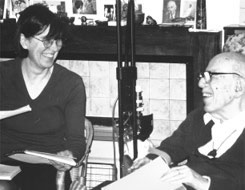
Caroline Mustill recalls the honour she felt in being asked to help renowned historian Ernst Gombrich to translate his children’s world history
A Little History of the World by Ernst Gombrich Yale University Press, £14.99 order this book
IN the summer of 1998, two black cabs drew up outside a unremarkable small suburban house in Hampstead, north London.
Out stepped a delegation from the Italian city of Mantua, which, led by the mayor, had come to bestow its laurels on the great art historian, Professor Sir Ernst Gombrich, in recognition of his long association with their city and as a tribute to his scholarly eminence. The 89-year-old Gombrich was by then too frail to travel, and received them in a room half-filled by his wife Ilse’s grand piano
Ilse served tea from a small trolley; the mayor made his formal presentation, cameras flashed and, to the delight of the delegation, Sir Ernst responded in Italian, with an elegant and witty speech. The legendary intellect and charm showed not a trace of age.
Three years earlier I had just completed a master’s degree in Renaissance history when a friend rang me out of the blue to ask if I would like to be Sir Ernst’s assistant.
My first reaction was one of surprise that the great man was still alive. Naturally, I was honoured and delighted at the suggestion, but I was also apprehensive: although I had read some of his writings, back in the 1960s, I knew very little about art history.
What use could I be to him? I had heard that he didn’t suffer fools gladly, and was afraid that I would be exposed as one in no time.However, when I met him at his house, after eyeing me sharply, he explained his predicament: for more than 30 years he had been gathering material for a book about the changing nature of artistic styles in Western art. Now time was running out, and this vast mass of documents and papers needed organising. My computer offered a way forward.
I soon discovered that, contrary to my fears, anyone who worked for the Gombrich household was welcomed, just as they had been in his parents’ home in Vienna.
At 86 Gombrich’s extraordinary intellect was still supported by a memory which retrieved all information without effort. His senses were similarly unimpaired.
Gombrich’s eye could still accurately compare an illustration in a book with the remembered original. One of my first tasks was to take a colour photograph to the Wallace Collection to check against a painting: the green seemed to him a shade too yellow, as indeed it was.
Four years later, in 2000, the completed manuscript of The Preference for the Primitive went off to the publisher, and in between visits to the Warburg Library for footnotes and illustrations there was time at last for relaxation.
Gombrich’s earliest published work Eine Kurze Weltgeschichte für Junge Leser (literally: A Brief World History for Young Readers), written in the space of six weeks shortly after his graduation in 1935, had never been translated into English, despite repeated requests from its publisher; other work was always more pressing.
Now he decided the moment had come to write an English version, with new chapters of interest to today’s young readers and minor updates.
He explained to me how he had been commissioned to translate from English a world history for children that was “unbelievably awful”, and had accepted the publisher’s challenge to produce something much better himself.
“To memorise a list of names and dates is hard and irksome; remembering a story needs little effort,” he says in his preface to the 16th-edition of The Story of Art. And so his history was planned as a collection of stories that would be written in an entirely new language, one far removed from the ponderous prose of school history books of his day.
The new version began to take shape as he read the book, translating into English and altering passages as he went to produce a rough first draft. It was entertaining work with much discussion of “false friends” (words which appear the same in two languages, but in fact have different meanings) and other traps for the unwary.
He would try out each new chapter on the nurse who had now become part of the Gombrich household, and was delighted by her genuine enthusiasm.
“I think it’s really not bad!” he said as I arrived one day for our session. However, with the need for further work coinciding with a sudden decline in his health it became clear that he would not finish the translation. When he asked me if I would complete it I was deeply moved, and honoured that he felt able to entrust it to me. Not long afterwards, he died.
Further work on The Preference for the Primitive, which was published posthumously, occupied me for some months. I worked together with Gombrich’s much-loved granddaughter and literary executor.
Later, Leonie’s determination and commitment spurred me on with the translation, and I was glad of her sure ear for her grandfather’s vocabulary and turn of phrase. In the process I learnt a lot about translation, and even more about world history and the art of the historian.
But, above all, I was struck by how Gombrich at 26 was already the man I had come to know at the end of his life; how deeply the principles of tolerance and reason were engrained in him, how well he already understood human nature, and how, despite all the horrors he was to witness in his lifetime, he never allowed himself to lose hope.
I count it the greatest privilege to have known him. In my copy of the Weltgeschichte he wrote: “For Caroline and children”. Its English version will enable many more children, and adults too, to enjoy these stories from history and draw comfort and inspiration from the wisdom and humanity of this extraordinary man.
Caroline Mustill is a historian who lives in Dartmouth Park.
|




