|
|
 |
| |
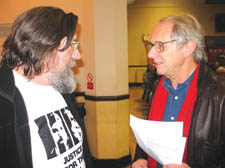
Ricky Tomlinson with Ken Loach |
Nervous Royle Family star speaks out
to call for inquiry
I KNEW exactly how Ricky Tomlinson felt when he chatted to me before mounting the platform to make a speech.
I remember how Jonathan Ross appeared as nervous as a kitten when I introduced him several years to a large crowd that had gathered for a Jobs Fair organised by the New Journal.
I met Tomlinson at a meeting held on Monday at the Welsh Centre in Holborn to drum up a campaign for a public inquiry into those dark years in the 70s when he and a fellow building worker Des Warren were jailed for conspiracy to “intimidate” during a strike.
All this, of course, was years before he became the TV star of today.
Looking ill at ease, he told me: “I’m bloody useless at learning lines as Ken Loach will tell you.
“I’ve had to make notes tonight. I’m going to speak for as little as possible and then open up for the floor for questions.” He kept his word.
His was a gritty tale of drugs being freely used in jail and hard times with warders.
Tomlinson started out reading from his notes but he soon abandoned them as sharp memories took over.
Bristling with anger he recalled how M15 monitored him before the trial and how a prisoner had spread a nasty rumour about him. He put a stop to that by confronting the inmate in the kitchen.
The meeting was attended by Arthur Scargill, Ken Loach and some of the other pickets who escaped imprisonment.
Scargill recalled the miners’ strike of 1984. “Even my fish and chip shop was being bugged,” he said.
He called for the public ownership of not just the banks but “every institution... so that we can keep the manufacturing base free from intervention” ending with a famous quote from the Chartist leader Bronterre O’Brien about the life of the poor: “The desire of one man to live on the fruits of another’s labour is the original sin of the world.”
Don waltzes around race row
IT has been something of a shock to see my old friend, the actor Don Warrington, strutting salsas, tangos, rhumbas and the like on TV’s Strictly Come Dancing for the last few weeks.
But nothing like the shock of seeing his face plastered across the front of the News of the World last Sunday.
Don had become the unwitting centrepiece of an enormous “Racist Beeb” splash manufactured by the paper, which claimed black contestants were unfairly booted off the show by the voting public because of the colour of their skin.
Whether there’s any truth to the accusations Don couldn’t – or wouldn’t – say.
However, he spoke fondly of the show, which he joined because he wanted to learn the “wonderful skill” of dancing, particularly the classic ballroom numbers.
Let’s hope this inflammatory row doesn’t cast too long a shadow over his waltzes.
Unlocking prisoners’ creative sides
I LEFT with a skip in my step as I walked out of the grounds of Wormwood Scrubs on Tuesday evening – despite the heavy sleet.
I had just had an exhilarating conversation with a man who clearly loves his work, helping to encourage prisoners to make art – painting, pottery, photography. It doesn’t matter which. What is important is that they discover their hidden talent, and perhaps find that art can begin to change their lives.
Tim Robertson, chief executive of the Koestler Trust, was showing me around an amazing collections of more than 2,000 works of art, mainly paintings, that seemed to cover every inch of a two-storey Victorian house next to the famous jail.
It was the evening of the private view of the annual Koestler Art Sale where paintings were going from £5 to £250, and some of them were very good.
A few – perhaps not surprisingly – had dark themes, but most were what you’d find at any collection of amateur art – amusing, uplifting, thought-provoking.
Altogether Robertson explained that 5,000 prisoners enter for the sale – each one receives a certificate, while about 2,000 go on to win awards.
The whole idea originated with the writer Arthur Koestler who had been incarcerated himself for political offences and whose novel Darkness at Noon became a classic.
Ironically, only the day beforehand, Justice Minister Jack Straw had berated prison reformers for being too soft on offenders.
As we talked Robertson mentioned Straw’s speech. Perhaps he recognised that Straw would have had people like him in mind – people who clearly believe prisoners shouldn’t be left to rot in jail but should be helped to transform their lives, perhaps through art.
He didn’t strike me as a sentimentalist. He is aware if you break society’s rules you must be prepared to be locked up. But he also believes there must be some purpose to imprisonment other than simply putting men and women behind bars.
Now in his 40s, Robertson hasn’t always worked for the Koestler Trust.
He started out as a social worker for Camden Council, working initially in the “frontline” with the child protection team.
He tired of that after a few years and worked under the social services director, then Simon White, drafting council policy.
But for a man of his beliefs and temperament it wasn’t surprising, perhaps, that he should find a more permanent home in the Koestler Trust. Keeping it alive isn’t easy. His main worry is to find £300,000 a year to cover basic overheads.
After the sale ends, Robertson will be off visiting most jails around the country to hand out his awards, sometimes feeling like a headmaster, he said, handing out certificates to bright pupils. His eyes lit up as he talked about that.
Problem of hospital’s speedier operation
HOSPITAL managers abandon common sense in the face of government targets, I find.
A friend in his sixties who was heart-stricken by the recent death of his brother rang up the University College London Hospital the other week to apologise for failing to respond to two letters fixing an appointment.
He had felt so upset by his brother’s death that he had simply forgotten to deal with his correspondence.
Was the appointments clerk sympathetic? Was she prepared to bend the rules that lay down that after two strikes you are out?
Not at all. “You have to go back to your GP and make another appointment,” she coldly told my friend.
When he protested that that would delay his visit to the specialist by at least two months, he was told: “It’s government policy – and nothing can be done.”
According to the clerk policies are policies and rules are rules – that’s how the UCLH red-tapers see their job.
The hidden agenda here is that the government is forcing hospitals to speed up waiting times for specialists by speeding up the appointments system.
In theory, a fine idea. But not if it is applied blindly – and bureaucrats in large institutions usually see patients through thick myopic lenses.
 |
 |
|
|
|
|
|
|