|
|
 |
| |
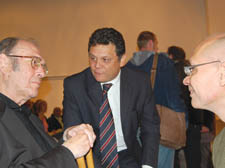
Harold Pinter, First Secretary of the Venezuelan Embassy Néstor Lopez and Venezuelan poet and special guest Luis Delgado Arria |
I will carry Pinter’s roar with me for some time
HE sat stick in hand, staring ahead, deep in thought. Occasionally, the faintest flicker of a smile crossed his lips as two men leaning over him whispered into his ear.
As soon as I had entered the packed hall in Grafton Way, Fitzrovia, my eyes were drawn to the man with the stick sitting on the last seat of the front row.
He was unmistakably Harold Pinter, Nobel laureate, the man who helped to change the British theatre with such plays as the Birthday Party and The
Caretaker.
He was also a man whom I knew didn’t take hostages when it came to meeting
journalists.
The last time I saw him in public was at a crowded Conway Hall where the air thundered with denunciation of the war against Yugoslavia in the 1990s.
Then, Pinter came onto the stage, stood silently for a few minutes and then roared out a poem against our foreign policy.
His unmistakable voice, beautifully cadenced, has stuck in my mind ever since.
I didn’t quite know how to start the conversion, so I said something that I thought would form an innocent introduction.
“I believe you are sympathetic to Cuba and Venezuela,” I said, bending so low that my face was parallel to his.
Pinter, of course, has never concealed his sympathies for Latin American states.
“Sympathetic!” he roared angrily into my face, barely a few inches from his.
“I’m not sympathetic, I’m a supporter!”
To try and bring the conversation onto a friendlier level, I told him that the last time I had seen him was at the Conway Hall meeting, and mentioned the names of the some of the speakers.
His face relaxed. I could say he smiled, in fact.
Just then, the meeting commemorating the overthrow of Salvador Allende in Chile 35 years ago began – a meeting organised by the Venezuelan embassy and held in Bolivar Hall, housed in a large building where the Latin American revolutionary lived in the 19th century.
After a few minutes two embassy members helped Pinter him up and steered him gently towards the six-inch high platform which they had to help him on to. He walked with great difficulty to a chair in front of the microphone.
Looking more relaxed, he recited four of his poems.
Afterwards he spoke, expressing his great affection for radicals in Latin America trying to create more equal
societies.
A great storm of applause swept through the hall when he stood up. A few minutes later he was helped again to leave the hall.
Pinter is known to be suffering from cancer, and is clearly unwell.
He probably insisted on helping to boost the meeting by his presence against his doctor’s advice. He certainly did, because the hall was packed.
Like many great men of letters he is obviously a passionate man.
He used to be an actor and he still has the voice of one. He roared at me – but I didn’t mind.
In fact, it was a memorable moment which I’ll pleasantly carry with me for some time.
Frank’s ferocious four hours in the freezing Firth
RAISE a piping hot toddy in honour of Frank Chalmers: I hear the Parliament Hill Lido pool regular has just completed a fantastic piece of derring-do.
Frank, 53, who lives in Lissenden Gardens, became the first
person last week to swim from the Orkney Isles to Scotland across the treacherous Pentland Firth, one of Britain’s most dangerous stretches of water.
Frank braved rough seas and water temperatures of around 12 degrees for nearly four hours, which many seafarers and swimmers had previously thought impossible.
As well as daily dips in the Lido, his preparation included regular trips to Dover Harbour where the Channel swimmers practise.
The sea between the Orkneys and Scotland is known as Hells Mouth, and apart from giant waves and strong currents, the safety boat that accompanied Frank had to keep a close eye out for killer whales.
When he entered the water he had planned to use the swim as a short, 30-minute preliminary swim to see if it was possible to get beyond rocks and currents around the Orkney coast.
But after the first stretch, the safety boat captain suggested he plugged on .
“I had not put on vaseline and we didn’t have hot high carbohydrate drinks on board either,” he said.
“But once I got started I just focussed on completing the swim.”
When Frank completed the eight mile stretch he promptly “threw up over the side”, he was so exhausted.
But he soon recovered to enjoy a celebratory party held in his honour back on the Orkney Isles.
When he swam the Channel in 2005, he promised his wife, Ros, who provided vital training support, that they would now do something she wanted to do.
“She replied she’d like to provide a home for foster children, so that’s what we did,” he told me.
‘How can we get rid of the Labour rebels?’
HERE’S an inside view of Tuesday’s meeting of the Labour Party’s national executive committee (NEC) over demands for Gordon Brown to resign as Prime Minister.
Gordon was there for 45 minutes, spoke to the committee made up of party members across the board before heading for Northern Ireland.
“And he got one very definite round of applause, which is something unheard of at NEC meetings,” NEC chairwoman Dianne Hayter told me at her home in Kentish Town.
“People were furious with the so-called rebels. Janet Anderson, the only MP among them who is on the NEC, didn’t even bother to show up and state a case. She just sent a text with her apologies.
“One man from the party’s Socialist societies, whom I represent, sent me a text message saying, ‘Can we have a ballot please on how to get rid of these non-entities!’
“There were loads of constituency and union members who sent similar messages to their NEC members.”
Ray Collins, the party’s new general secretary, who lives in Islington – it was his first NEC meeting – made it clear that while elections for leader and deputy leader are held annually when Labour is in opposition – the last time in 1996 – the rules (Chapter 4, clause D) state that no such elections are held when Labour is in government unless demanded by a majority card vote at party conference.
“And the rebel MPs know that,” explained Dianne. “They were just using the idea to grab the headlines.”
The only way the
party can discuss the possibility of changing its leader is for an
emergency resolution to be tabled by either the trade unions, the
constituency Labour parties or the party’s Socialist societies.
“That’s never going to happen when there is truly financial turmoil in the world and at a time when the government has to concentrate on that vital problem,” added Dianne.
“That was the point everyone was making when we had a general discussion and about a dozen people spoke.
“My year as chairwoman ends next week. I was so proud of the NEC and to have been in the chair for Tuesday’s meeting.”
Wanted: £120,000 to save a party’s soul
IS the Labour Party about to lose its soul?
The left-wing weekly Tribune – which for more then 70 years has played host to Labour luminaries such as George Orwell, Aneurin Bevan and Michael Foot – faces closure.
It is based in a grand
Victorian house in Arkwright Road, Hampstead, once the family home of the flamboyant conductor Thomas Beecham.
The union Unite, the magazine’s largest shareholder, has failed to follow up
on investment promises
made in March.
Journalist Geoffrey Goodman – ex-industrial reporter for the Daily Mirror – told me: “Basically they need a load of cash immediately – something in the region of £120,000.
“Tribune appears to have been let down by the unions. For it to go down now – on the eve of the Labour Party conference – would be very damaging psychologically.
“I don’t have a solution – but perhaps some partnership can be made with the New Statesmen?”
 |
 |
|
|
|
|
|
|