|
|
 |
| |
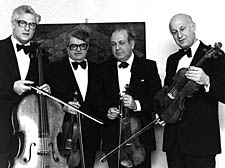
Amadeus Quartet, from left: Martin Lovett, Sigmund Nissel, Norbert Brainin, Peter Schidlof |
Violinist who fled from Nazis
VIOLINIST Sigmund Nissel, who has died aged 86, had a key role in one of the world’s leading string quartets.
The second violinist in the Amadeus Quartet, he took part in more than 200 recordings, countless live performances around the world and passed on his talents to hundreds of students at the Royal Academy of Music. He lived in Golders Green and Hampstead.
Born in Vienna in 1922, he first took up the violin aged six, after his family had moved to Munich. After his mother’s death when he was nine, he returned to Vienna and was taken under the tutelage of Max Weissgarber. His life changed for ever the day the Nazis marched into Austria in 1938. His father realised their time in Vienna was limited, and Sigi was put on one of the kindertransports, mercy missions for young people.
To stay in England, he had to prove he had private funds to support himself, or the promise of work. Sigi had no one to offer such guarantees. His answer was novel. He decided to select at random a street in Hackney, and knock on doors until someone said yes. Amazingly, he found a family willing to listen to his story and agree to help.
After securing his right to be in England, Sigi was taken to a boy scout camp in Seaford, Sussex. He spent the summer of 1939 fretting about the safety of his father, still in Austria.
Watching the British military preparations near his temporary south-coast home, Sigi decided to place a call to Vienna to plead with his father to leave as soon as possible. But he had no money to do so. The only person he knew with a phone lived in London. Sigi borrowed a bicycle and pedalled 65 miles through the night. He called his father and told him he had to leave, by any means, immediately. It saved his father’s life.
Sigi was then interned, and sent to the Isle of Man with other German émigrés. He was held as an enemy alien until composer Ralph Vaughan Williams wrote a letter to the government vouching for his good character, sound anti-Fascist beliefs and protesting at his incarceration. He was freed, and returned to work as a metal worker, which allowed him to continue his development as a musician.
His time in the camp had a positive outcome: it was here he met two other members of the quartet, Peter Schidlof and Norbert Brainin. They befriended music writer and radio producer Hans Keller, who lived in Hampstead. He was to become a lifelong supporter of their work.
Throughout the war, the three played together, before befriending young cellist Martin Lovett. They rehearsed together, liked what they produced and in 1948, at the Wigmore Hall, the Amadeus Quartet made their debut performance, the first of many concerts that were to stretch over 40 years.
They chose Amadeus as their name because they thought it “embraced love’’ as well as being Mozart’s middle name.
They were quickly nicknamed the Wolf Gang. Their final performance was at St John’s Hampstead Parish Church, in Church Row, quartet disbanding when Peter passed away in 1987.
Sigi’s friends recall a charming man with a wide range of interests. Artist Melien Cosman, married to Hans Keller, sketched the quartet and socialised with them.
“He was a superb conversationalist,” she recalled.
Sigi earned a reputation as a formidable teacher in Cologne and at the Royal Academy in London.
Martin Lovett, the last remaining member of the quartet, said: “Out of the four of us, he was the most successful teacher.”
DAN CARRIER |
 |
|
|
|
|
|


