|
|
 |
| |
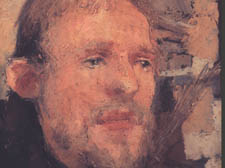
Who is this? One of artist Robert Lenkiewicz’s paintings entitled Study of Someone in Hampstead, from 1958/60. It sold for £2,000 |
Frame but not fortune of Lenkiewicz?
THE artist Robert Lenkiewicz, who grew up in West Hampstead, seems to be as much a mysterious figure in death as he was in life.
I still can’t figure out how Lenkiewicz, in death, came to owe the Inland Revenue something in the region of £3 million. But he did.
And at a recent auction of more than 500 of his works another £2 million was raised by Lenkiewicz’s executors to help meet the pressing demands of the tax man.
So far, since his death six years ago, more than £4 million worth of his paintings have been sold off.
A loud gasp went round the auction hall in Exeter when his magnificent 36ft-long mural, The Temptation of St Antony, was sold for £170,000. A few minutes later I walked over to the mural to take my last look at it, wondering who had bought it.
Later the auctioneer, Daniel Goddard, told me it had been bought by a Halifax builder who loves Lenkiewicz’s works. A wealthy art lover, obviously.
Another £100,000 went on a painting of a vagrant titled The Bishop Startled which was last seen at an exhibition in Parkway, Camden Town, earlier in the year.
Who was Lenkiewicz? He was one of three sons born to a couple who fled the Nazis at the end of the 1930s and opened a little hotel, the Shem-Tov in Fordwych Road, West Hampstead.
A gifted student at St Martin’s School of Art, he turned his back on the fashionable London art scene in the 1960s when he was in his early 20s and moved to the West Country – never to return. He was said to have had 12 “wives” and fathered several children.
A superb draughtsman, he became an outstanding figurative artist, astonishingly Rembrandtian in style, and liked to paint people at the bottom of the pile – vagrants, the handicapped and prostitutes.
Feverishly, he couldn’t stop working and must have completed a painting every day. Judging from the auction, some of them had been dashed off. Others had been executed simply to pay the bills – such as his Adam and Eve or porn works, for which there is always a lucrative market.
Several of his paintings will soon be exhibited at The Boundary Gallery in St John’s Wood who are staging works by Jewish artists.
Wally on why ‘Humph’ really was top brass!
WALLY Fawkes, the jazzman cartoonist known as Trog, now 83, added his own poignant tribute this week to Humphrey Lyttelton, the trumpeter and brilliant broadcaster who has died at the age of 86.
They met 61 years ago when Wally was playing his clarinet with the George Webb Band at a concert and Humph was on the same bill.
“It was love at first sound,” Wally told me at his home in Glenhurst Avenue, Highgate.
“We were all so impressed with Humph’s trumpet playing. He was so dedicated and enthusiastic, a real jazzman at heart, who gave such a strong lead to the band. He was a man besotted with his music.”
Wally became a founder member of the Humphrey Lyttelton Band in 1948 and played with it until 1956.
“Humph and I used to have musical conversations on the stand, talking to each other with our instruments,” he recalled.
Wally then decided to concentrate on his career as a cartoonist, playing jazz for fun, but he was always in close contact with Humph, who at one time in his career lived in East Heath Road, Hampstead.
For a while Humph wrote the witty script for Wally’s famed Flook cartoon strip in the Daily Mail.
“And in later years he became more relaxed as a musician,” said Wally.
“We last played together at a charity concert Humph gave at the Royal Free Hospital in March last year.
“He invited me to play three numbers, one of them Trog’s Blues, my old theme tune with the band. There wasn’t a dry eye in the house.”
Still a slick operation
STILL full of warmth and given TLC, an expression known among nurses and doctors, I returned to University College London Hospital on Tuesday morning for a fresh dressing of my arm.
Readers may recall that last week I enthused about the efficiency of the National Health Service following an operation on my left arm.
Again, it was full marks to the UCLH.
I had to wait for only a few minutes before a male nurse called me in, took my bandage off, sprayed iodine on the sutured wound, and then covered it.
This week the Royal College of Nursing criticised the four-hour maximum wait for patients in accident and emergency rooms. The RCN said it often led to patients being patched up and packed off to wards to finish the treatment.
There are pros and cons here. Positive: the rule gives much-needed deadlines to A&E staff.
Negative: the odd patient can end up having split treatment.
• |
 |
|
|
|
|
|
|