|
|
 |
| |
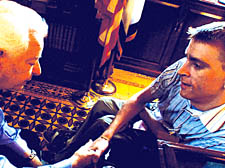
Soldier Tomas Young, paralysed by a bullet in Iraq, meets Senator Bob Byrd in Body of War |
Trapped for life: Iraq veteran carries fight to top
PARALYSED from the neck down and trapped in a wheelchair for life after being shot in the neck in Iraq – that’s the future facing US soldier Tomas Young whose harrowing days are followed in a new documentary, Body of War.
In story-line it’s a bit like the film Born on the 4th of July, though more horrific. The Washington cinema I saw it in was pretty full. If it is shown in this country will it attract as strong an audience?
American slump is a little close to home
IT’S coming, but you’d hardly be aware of it judging by the sparse coverage given to it by the mainstream dailies and TV newscasts in Britain.
I am referring to the economic slump, which has been euphemistically described as a “credit crunch” in our dailies, and a housing crash.
It’s just the opposite in Washington and New York where I have spent the past few days.
There the main topic on practically every news channel is the number of families losing their homes in “foreclosures”.
In Washington alone thousands of families, unable to meet higher mortgage payments raised by banks, have lost their homes.
Most of them were sucked into low-interest deals about three years ago with banks, but when the fixed-interest periods began to end in the past six months or so they were unable to meet the new charges. The low income and middle-class families aren’t blamed for being spendthrift. Blame is targeted at the banks condemned as being “greedy”.
At a Senate hearing I attended, Senator Amy Klobuchar, representing Minesota, said that the American dream of owning a house had become a “troubled dream”.
Nor can you escape news about the recession on TV.
But where pockets are being emptied other pockets are being filled. In one absorbing 15- minute TV “advertorial” a property dealer plugged his latest book promising readers they could make fortunes from “foreclosures” by “buying” mortgage agreements on the cheap from home-owners frantic to get rid of them. Have no qualms about taking a home away from a family purred the guru on housing. You’d be doing them a favour.
By taking over their mortgage at the last gasp you enable the stricken family to stay off the money-lenders’ bad credit list.
Always courted for his views is George Soros, the billionaire who once worked for Camden’s ex-finance chief John Mills as a junior salesman in his import business run from the basement of his home in Albert Street, Camden Town.
In a Washington Post feature, headed “Double Bubble Trouble”, Soros warns of a “bursting” real-estate bubble along with a “bursting” financial crisis spawned by decades of a debt built up by US families.
And the Iraq war? It’s a war most of our media appear to have forgotten.
But, again, there’s non-stop newscasts and chat-shows on the war on US networks.
There’s a consensus in the US it’s going badly, and Bush is blamed.
Contrast all that with the British media – and I find ours wanting.
Have newspapers, like the Washington Post and the New York Times got more integrity than ours?
Our doctors leading the way to save kids’ sight
TWO leading international authorities on eye surgery from Moorfields Eye Hospital in Islington and Great Ormond Street Hospital for children gave workshops for doctors at a five-day world medical convention in Washington, I attended.
I met both men, Professor John Lee, from Moorfields, and Ken Nischal, from GOSH, and members of their staff.
An illustrated poster depicting new methods of corneal transplants on children – authored by Mr Nischal and, among others, a Kentish Town surgeon, Samantha Harding – was voted among the top 10 best posters.
Imagine going blind for life because a simple, early, symptom goes untreated. That’s what happens in India where, according to a poster by Mumbai doctors, there are more than three million blind children.
The doctors had set out a screening process that would save eyes – if only the Mumbai local government would back it.
But that, according to a woman doctor I spoke to, seemed unlikely.
Radio relives story of fight against fascists
HE’S one of the greatest characters I know in Camden, and I’m glad the story of his fight against post-war racists will be aired again on Radio 4 on Saturday night.
Morris Beckman, 87, will tell how he helped form a group of men known as the 43 Group – dedicated to fighting the politics of hate in the late 1940s when the fascists, led by Oswald Mosley, had suddenly re-emerged.
It all began when Morris and three friends went to Jack Straws pub in Hampstead one Sunday night and found themselves at a fascist rally.
“There were some thugs selling a paper while one of their leaders was going through the usual rant against Jews,” Morris told me.
Among others, Gerry Flamberg, a paratrooper, Alec Carson, a fighter pilot, and Morris himself a veteran merchant seaman sent the fascists flying that night.
Their fame spread, and for the next year or so an end was put to the poison of racism in London.
Broadway off night
TO my surprise I found Washington alive with good theatre.
An August Wilson season ran to packed houses with the mainly black audience – the night I saw Wilson’s Seven Guitars – joining in the drama with cheers and sympathetic noises.
I also saw one of the finest productions of Arthur Miller’s a View from the Bridge – another crowded theatre.
In New York hopes rose when I booked hot tickets for film star Morgan Freeman and Kathleen Frances McDormand in a Broadway revival of a Clifford Odets play, The Country Girl.
But what a disappointment! They are among my favourite movie actors but they proved pretty lifeless on the stage.
Prising the vets away
I FAILED where reporters on the Washington Post had succeeded. They won Pullitzer prizes last week for their exposé of the shocking treatment of Iraq war veterans at the Walter Reed Army Hospital in the capital.
Their heart-wrenching pieces appeared a few months ago. But, I confess, I didn’t get very far when I tried to talk to the same veterans early one evening.
Heavy security men at the gates leading to the suburban hospital grounds made it clear I wasn’t welcome. Good sense got the better of valour, and, frustrated, I decamped.
 |
 |
|
|
|
|
|
|