| |
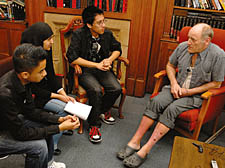
From left: A-level psychology students (from left) Shehid Ahmed, Sujna Begum and Roshan Manandhur with war veteran David Treharme, 57 |
Soldiers offered a ‘talking cure’
Students meet traumatised war veterans and follow Freud’s method to combat stress
EX-SOLDIERS traumatised by the horrors of war have forged an unlikely partnership with students from a Somers Town secondary school to break down the boundaries surrounding their condition.
In a unique project organised by the Freud Museum in Hampstead, veterans from Combat Stress, the Ex-Services Mental Welfare Society met A-level psychology students from South Camden Community School (SCCS) to discuss the impact conflict had made on their lives.
Their experiences form the core of an oral archive which will provide the students with first-hand sources to explore the mental effects of battle and offer victims of trauma the “talking cure” of psychoanalysis, propagated by the Austrian psychiatrist Sigmund Freud.
Anna Lotinga, development officer at the Freud Museum, admitted it had been a “risky and unusual project” for the museum: many of the predominantly Muslim interviewers wore headscarves; many of the veterans had served and suffered their traumatic conflicts in the Middle East.
Ms Lotinga said: “We were attracted by the theme of ‘conflict’ and wanted to examine its psychological effects.
“It’s an important current issue that is not widely understood.
“But,” she added, “none of us anticipated what a personally meaningful experience it would be for everyone involved. I think a lot of perceptions have been changed.”
The first part of the Museums, Libraries and Archives Council-funded project “Archaeology of Conflict: Unearthing the Psychological” drew on Freud’s “archaeology” metaphor – students attempted to dig beneath the familiar stories of the veterans and discover hidden thoughts, feelings and links between life events.
Stories from the frontline showed a range of mental scars – some accumulated over years of combat, others brought about by a single, harrowing event.
One soldier who had served in Bosnia said he still avoided barbecues because he could not stand the smell of burning meat.
Another confessed he had talked more about his problems to the teenagers than to anybody at home, whom he felt “did not understand”.
The interviews will also be used by SCCS drama pupils to create a performance piece.
Freud believed soldiers who suffered from war neuroses were suffering emotional conflict brought on by their war experience.
Rather than the brutal electric shock treatment being used at the time to get soldiers fit again for active service, Freud advocated psychotherapy as a better and more humane form of treatment.
He thought there was something “beyond the pleasure principle”, exhibited when victims of life-threatening trauma remembered and re-enacted their experiences over and over again.
Freud spoke of the “repetition compulsion” and introduced the concept of the “death drive”.
Ms Lotinga added: “Freud calls for a little more ‘psychological truthfulness on all sides’ – that is one of the many things that I feel this project has achieved.” |
 |
| |
|
|



