Camden New Journal
Publications by New Journal Enterprises
spacer
  Home Archive Competition Jobs Tickets Accommodation Dating Contact us
spacer
spacer
spacer
spacer
spacer
spacer
spacer
Camden New Journal - HEALTH by TOM FOOT
Published: 13 March 2008
 
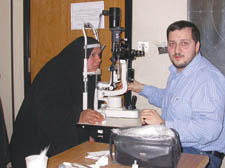
 Haidar Al Hakim at Al-Sadr teaching hospital in Najaf four years ago
Haidar Al Hakim at Al-Sadr teaching hospital in Najaf four years ago
Saving sight and raising hope in the war-torn ruins of Iraq

‘I thought crikey, if I don’t do it no one will’ – a Royal Free doctor’s mission to his home


A ROYAL Free eye doctor is visiting his hometown in Iraq to carry out crucial operations 30 years after his family were executed under President Saddam Hussein’s regime.

Haidar Al Hakim, 33, first returned to the devastated city of Najaf in 2004, following the allied invasion in 2003.
He saw first-hand how the city’s hospitals had been been destroyed by US bombs.
With crucial supply lines to hospitals cut, surgeons had been performing operations on young children in primitive conditions.
“There were no facilities for specialist medical care and no equipment,” he said. “I thought: ‘Crikey – if I don’t do it, no one will’.”
Mr Hakim returned to work at the Pond Street hospital where he got talking to a patient about the problem. Together they started a charity called Al Hasan – after Mr Hakin’s son – securing a £13,000 start-up grant from the government. Since then he has made a series of trips to war-torn Najaf, opening a specialist eye clinic there.
“Najaf is a city about 160 kilometres south of Baghdad,” he said. “It is known for having the biggest graveyard in the world. All the people in southern Iraq are buried there. But at the same time it is one of the more prosperous cities in Iraq. If you see what it is like there, it makes you wonder what the situation is like in the smaller cities.
“When we were out there we did a hospital survey and we found that 40 per cent of the over- 50s were blind or visually impaired. Cataracts are the main problem and diabetes too. There are no machines for diabetes.”
He added: “We started performing cataract operations and glaucoma treatment in early 2004.
“We set about fund-raising for an ultrasound machine. I stayed there for about 14 months teaching ophthalmology as a university lecturer. I was getting paid about £200 a month and couldn’t sustain my mortgage back home so I had to come back.”
Mr Hakim said before the Al Hasan charity was set up thousands of pounds worth of crucial equipment sent to Iraq through fundraising was being intercepted.
He said: “We have sent 26 boxes of medical equipment through reliable and reputable sources. If you don’t know the people one hundred per cent, it is likely to go missing.”
He said the problem stretched back from before the 2003 invasion.
He said: “There was an embargo in 1994 and before that an eight-year war with Iran. Ever since the 1980s it has been very difficult.”
“But when Saddam went on the run he opened all the prisons. There were 300,000 prisoners in Iraq and a lot of armoury.
“It only took a little bit of money from people and militia sprang up everywhere. That is one of the biggest problems.”
Orbis, the flying eye-hospital, takes qualified surgeons across the world saving millions from blindness.
While flights have not touched down in Iraq since the conflict, Mr Hakim said it was possible to get help there if you knew the right people.
“But since 2007, things are getting better. The Government is much stronger and there is a proper police force. Things are definitely on on the up.”

Comment on this article.
(You must supply your full name and email address for your comment to be published)

Name:

Email:

Comment:


Your comments:


spacer


spacer


Theatre Music
Arts & Events Attractions
spacer


  up